Most chemical processes contain chemicals that are flammable, toxic or reactive. Process Safety Management (PSM) is a management system comprised of policies and procedures that are used to control the hazards of these chemicals. All chemical companies have had methods for controlling the hazards of chemicals for many years, although few called it process safety management. However, the methods used varied from company to company in methodology and effectiveness. Failure to have an adequate Process Safety Management system is frequently a root cause of catastrophic incidents.
Process Safety Audits
Process Safety deals with the design, operation, maintenance, and management of a process in a manner such that the risks and hazards to the employees, the public, and the environment are minimized. The guiding principles of process safety require that Recognized and Generally Accepted Good Engineering Practice (RAGAGEP) be used. These practices are specified in numerous consensus standards from professional organizations (i.e.: AIChE, ASME, NFPA, etc.) and have become law in many cases under OSHA’s PSM regulation and EPA’s RMP rule. These practices have been used for a long time; even before the OSHA and EPA regulations were promulgated because many companies recognized that the use of them provided financial rewards. Many managers have recognized that processes which operate safely and reliably usually also have high productivity, minimal incidents, high product quality, and reduced costs. These managers embrace the concept of RAGAGEP and insist that the methodology is fully implemented.
I offer over forty years of experience in developing and using process safety in the design, operation, maintenance, and management of processes and facilities. Areas of expertise include: Process Hazards Analysis, Risk Assessment, Process Safety Information, Technology Safety Data Sheets, Operating Procedures, Maintenance Procedures, Training, Incident Investigation, Emergency Planning and Response, Emergency Response Data Sheets, Continuous Improvement, Management of Change, Work permits, Pre-Startup Safety Review, Employee Participation, Contractor Safety, Inherent Safety, and Auditing. A comprehensive auditing protocol is used to determine: the degree to which RAGAGEP has been used, OSHA’s PSM regulation compliance, EPA’s RMP rule compliance, and to identify gaps and areas for improvement. Assistance is also available in closing any identified gaps, or in providing guidance on how to do the work yourself.
During my career, I have performed or supervised all of the elements of Process Safety Management and understand what is required to have an effective program.
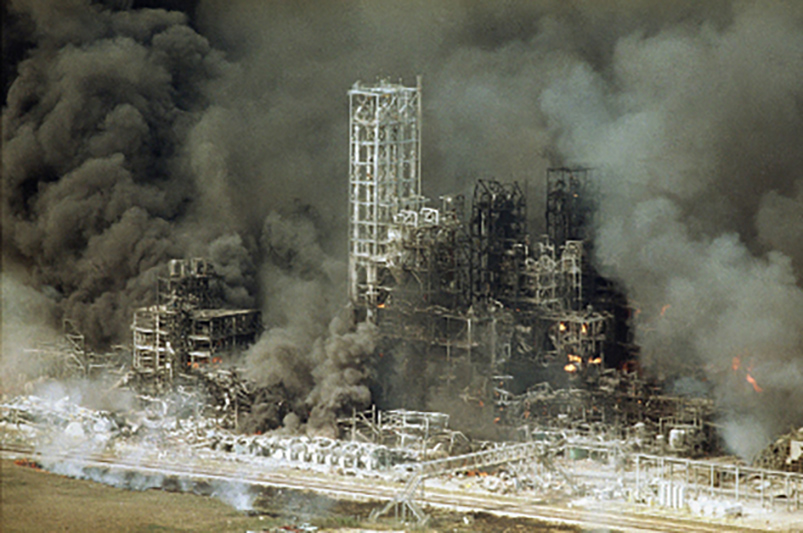
On October 23, 1989, there was a massive explosion at the Phillips Petroleum Company Houston Chemical Complex that resulted in 23 deaths and kick-started OSHA’s Process Safety Management regulation.
The fire and explosion that sparked the PSM regulation (Photo from U.S. Fire Administration report)
Employee Involvement
The knowledge and experience of operators and maintenance personnel are to be taken into consideration when developing procedures and performing hazard analyses.
Process Safety Information
Information about the chemicals used in the process, the technology of the process and the equipment used in the process must be available. Information such as compositions and flash points are required. Process flow sheets, P&IDs, electrical classification drawings and safety system information are also required. The process must be designed following RAGAGEP. Applicable RAGAGEP include those provided by the ASME, API, NFPA, AIChE and others.
Process Hazard Analysis
The owner/operator of the process must perform a hazard analysis that identifies the potential hazards of the process and how those hazards are to be controlled. The analysis is performed by a team of personnel that are knowledgeable in the process. Deviations from intended operation are analyzed to determine the consequences of those deviations and what safeguards are present to protect against those hazards. A determination is made of the adequacy of the safeguards, and if appropriate, additional safeguards are recommended. All of the recommendations must be addressed prior to startup of the process.
Operating Procedures
In order to operate and maintain the process in a safe and responsible manner there must be written procedures for the operation and maintenance of the facility. The operating procedures must include such things as startup; shutdown; upper and lower limits for variables such as temperature, pressure and flow rate; the consequences of deviating from these upper and lower limits; and the corrective actions to take if an upper or lower limit is approached or exceeded. These procedures ensure that each operator operates the Unit in a consistent manner and that the procedures have been developed, reviewed and approved by management. Without such procedures, the operator must decide for himself how to perform the work and how to respond to deviations. There must also be safe work procedures for such things as personal protective equipment, hot work, confined space entry, lockout/tagout and line breaking and equipment opening.
Operator Training
It does no good to have operating procedures if the operators do not know what the procedures are or if they choose to not follow them. Operators must be trained in the process and receive periodic refresher training.
Contractors
Contractors that perform work in the refinery must know the hazards associated with the work that they are to perform and what safeguards are provided to protect them from those hazards. The contractors must also be trained how to safely perform the work that they are asked to do.
Mechanical Integrity
Procedures are required for the maintenance, testing and inspection of equipment to ensure that the equipment meets the original design specifications. The procedures must contain sufficient information to safely and effectively perform the required work. The personnel involved in performing the work must be trained in these procedures as well as in the hazards associated with the work to be performed and what safeguards are provided to protect them from the hazards. Procedures are also required to ensure that the work has been performed correctly and that the work meets the original design specification. Any equipment that does not meet design specifications must be repaired or replaced before it is placed back in service unless another means is used to ensure that the process can be safely operated.
Management of Change (MOC)
Anytime a change is made in chemistry, technology, equipment or procedures, there is the potential that new hazards will be created. Prior to making any change it is necessary to evaluate the change in depth to determine if new hazards are created and if so, ensuring that the existing safeguards are adequate. If the safeguards are not adequate, either additional safeguards must be added, or the change must be rejected. An important part of the MOC process is ensuring that a team of knowledgeable personnel review the change and perform the analysis. Management is responsible for reviewing the work of the analysis team and approving any changes. The level of analysis must be at least equivalent to that required when performing a Process Hazards Analysis (PHA).
Pre-Startup Safety Review
Prior to starting up a process that has been down for maintenance, or after a change has been made in equipment, chemistry or procedures, a review must be done to ensure that the process is safe to start up. The employer must ensure that all maintenance work has been completed in compliance with their mechanical integrity program and design specifications, all procedures are up to date, all training on any changes has been completed, and all action items from process hazards and management of change reviews have been completed.
Incident investigation
When an incident occurs that results in a loss of containment, or could foreseeably have resulted in a loss of containment under slightly different circumstances, an incident investigation must be performed to identify the root causes of that incident. Corrective actions must then be taken to provide changes in the process or addition of safeguards to ensure that the incident, or a similar incident, cannot recur. The analysis is performed by a team of knowledgeable engineers, operators, involved contractors and safety professionals that have been trained in incident investigation methodologies.
Emergency Planning & Response
When an emergency occurs, such as a fire, explosion or release of toxic material, the personnel in the facility must be trained in what actions to take such as reporting the emergency, evacuation procedures, shelter in place procedures and the actions of emergency responders and those that remain in the facility to operate or shut down the process. There must be written procedures that are applicable to both large releases and small releases.
Compliance Audits
Just having a Process Safety Management program is not enough to comply with Federal regulations and RAGAGEP. That program must be implemented, adequate and followed. Federal regulations and RAGAGEP require that the management systems, policies and programs be audited for compliance with requirements and are being followed at least every three years. Furthermore, the employer is required to issue a report of the audit findings and the actions that were taken to correct any deficiencies. As with all auditing, the audit team should be independent and contain persons knowledgeable in proper auditing techniques and the requirements that are being audited.

 Phone: